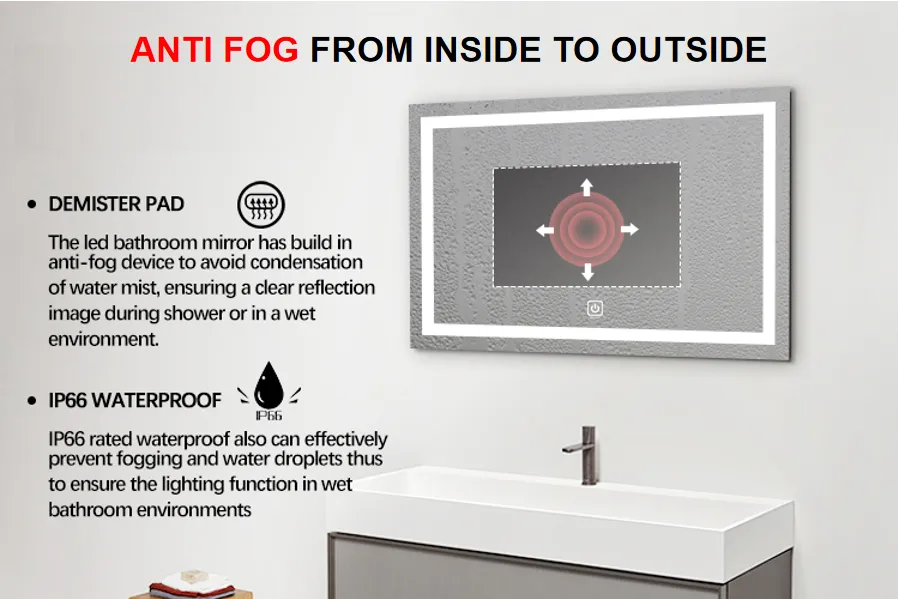
What a demister actually does
Fog is condensation. Humid air meets cooler glass, the surface falls below the dew point, and moisture settles as droplets that scatter light. The mirror is not dirty; it is effectively frosted.
A demister does not dry the air or clean the glass. It holds one surface just above the dew point, so condensation has nowhere to settle. That explains nearly every practical limit:
· The element heats only the glass directly in front of it. Everything outside it still fogs.
· It works while powered. Switch it off and the surface behaves like any other mirror.
· Warm glass feels warm to the touch. Normal, not a fault.
Know which mechanism you are buying, too. Some products claim "fog-free" on the strength of a surface treatment on the glass; others use an electric heating element. Both are called anti-fog, their long-term behaviour differs, and their warranty terms are not interchangeable. If a quotation says "anti-fog" and nothing else, ask which one it is.
The three numbers that decide whether it works
1. Watt density, not wattage
100 W spread over 1 m² and 100 W over 0.2 m² are different products. What counts is watts per square metre of heated area. Published datasheets for self-adhesive demister pads — thin films bonded to the back of the glass — cluster between roughly 180 and 260 W/m²:
Product | Market | Heat output | Thickness | Declared compliance |
Warmup Mirror Demister (360 × 560 mm) | UK | 200 W/m² | 0.4 mm | CE, UKCA, IP54 |
Demista SELV pad (800 × 300 mm) | UK | 43 W ≈ 179 W/m² (calculated) | — | SELV 12 V |
ClearMirror Original | US | up to 0.17 W/in² ≈ 264 W/m² | 0.3 mm | UL listed |
200 W/m² is a sensible default for domestic and hotel bathrooms. Below about 180 W/m² the surface clears slowly and a long, hot shower can outrun it. Above about 260 W/m² you are buying speed with heat — and heat has a cost elsewhere in the assembly.
2. Heated area — the fog-free zone
This is the number most often missing from a quotation, and the one that causes the most disappointment afterwards.
A pad covers a rectangle; the mirror may be larger. A 20 in × 30 in pad (508 × 762 mm) is about 0.39 m². Behind a 1,200 × 800 mm mirror — 0.96 m² of glass — roughly 40% of the surface is heated. The rest fogs, however good the pad is.
That is not necessarily wrong. Heaters concentrate where the face actually is, and heating a whole over-vanity mirror spends power on glass nobody looks into. What is wrong is leaving the customer to discover the boundary. State the fog-free zone as two dimensions in the line-item description, and mark it on the approved sample. Where the whole surface must stay clear, specify multiple pads.
3. What switches it on, and what switches it off
Three arrangements are common. Wired through the bathroom light: simple and cheap, but the mirror is warm whenever the lights are on — hours at a time in a hotel. A dedicated switch or touch sensor: the same capacitive key that runs the light triggers the demister second, and many designs then time out automatically. A timer or presence logic: the best energy profile, and the one that best survives a hotel's duty cycle.
Run the arithmetic before choosing. A 200 W/m² pad behind a 560 × 720 mm mirror draws about 81 W; half an hour is roughly 40 Wh, or 0.04 kWh — about a quarter of the energy in a 2 kW hairdryer used for five minutes. Running cost is not the argument against leaving it on. The hours the glass spends hot, and the thermal cycling that puts the coating and the adhesive through, are.
The trade-off that is not on the datasheet
A mirror is not bare glass. It is glass, a reflective layer, a copper layer and coats of backing paint — and a heating film bonded to that stack is a heat source clamped against a paint film.
Where the bond is complete, heat spreads evenly. Where it is not — a trapped air pocket, dust on the backing, a wrinkle in the adhesive — that pocket becomes a hot spot, which can discolour the backing and print a mark through to the reflective side.
So the questions worth asking are not about the pad alone. Is it applied under controlled conditions, with a documented bond check? Is surface temperature verified across the whole heated area rather than the centre — an IR scan takes seconds? Is the element cuttable, if the sizes do not line up? Most field failures here are not electrical. They are thermal.
What to write into the purchase order
A specification that is not written down is one nobody is responsible for. A demister line item should carry:
1. An explicit statement that an electric anti-fog element is required — or that it is not.
2. Heat output in W/m², and the heated area as two dimensions in millimetres.
3. Supply voltage and construction class (Class I or Class II), and whether a driver or transformer is included.
4. How it is switched, whether an automatic time-out is fitted, and the element's IP rating against the bathroom zone.
5. Test evidence — time-to-clear, surface temperature uniformity, dielectric withstand — plus the anti-fog warranty term, stated separately.
That is a longer line item than "with demister". It is also the difference between a mirror that works in year four and one replaced in year two.
FAQ
Does it work instantly? No. Glass has thermal mass — switch it on before you shower, not after.
Is it expensive to run? Not in absolute terms: about 0.04 kWh for half an hour behind a 560 × 720 mm mirror. Component life, not energy, is the reason to fit a timer.
Can it be retrofitted? Self-adhesive pads are made for it. The constraint is the supply — whether a suitable switched supply exists behind the mirror.
For trade buyers
We build LED mirrors and mirror cabinets with integrated demisters to order: watt density, heated area, control method, supply voltage and IP rating specified per project rather than picked off a shelf. Production runs in our own 48,000 m² factory — glass processing, coating, LED and demister assembly, testing and packing under one roof — against CE, CB, SAA, ETL, RoHS and IP-rated market requirements, shipped to more than 60 countries with a 3-year standard warranty.
Send us the mirror size and the fog-free zone you need, and we will come back with the pad configuration, load figures and test documentation.