A Large Domestic Market Driven by China’s Real Estate Boom
China’s domestic property market played an important role in the development of its LED mirror industry.
During the real estate expansion of the 2010s and early 2020s, large numbers of apartments, hotels, offices, shopping centers, and commercial buildings were constructed across the country. Each development generated demand for bathroom mirrors, mirror cabinets, lighting products, sanitary ware, furniture, and other interior products.
The scale of this demand was exceptionally large. In 2021, Chinese real estate development enterprises had approximately 6.9 billion square meters of residential floor space under construction. This level of construction encouraged manufacturers to invest in mirror production lines, coating equipment, LED assembly, engineering, quality-control systems, and greater manufacturing capacity.
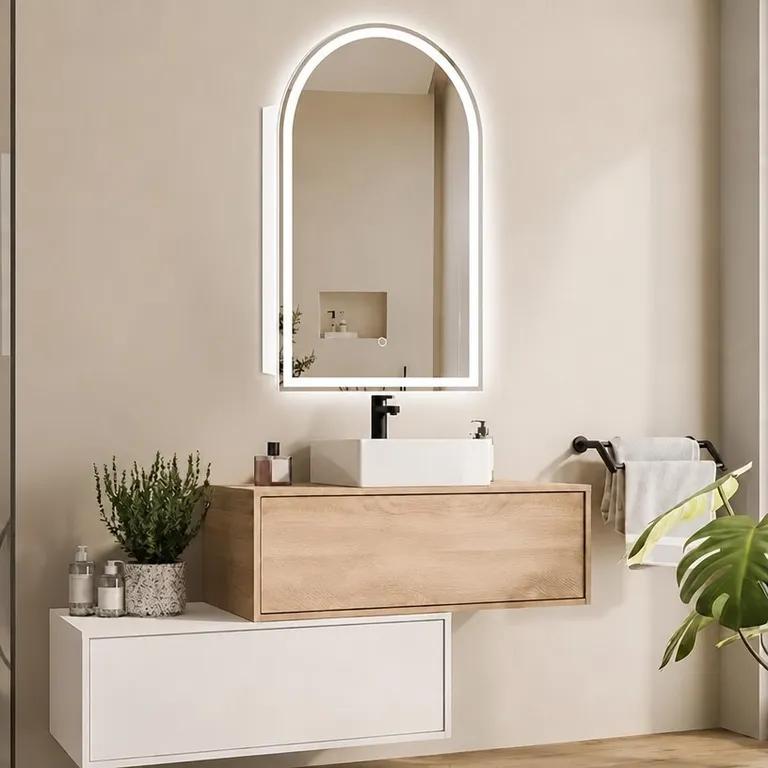
Domestic demand also helped the industry move beyond basic reflective glass. As homeowners, hotel operators, and property developers looked for more functional bathroom products, manufacturers developed mirrors with LED lighting, anti-fog systems, touch switches, motion sensors, adjustable color temperatures, digital displays, and other smart functions.
The real estate boom therefore did more than generate orders. It created sufficient production volume to support specialized mirror factories, coating companies, electronics suppliers, hardware producers, packaging manufacturers, engineers, and skilled production workers.
Although new construction has slowed from its earlier peak, the industrial capabilities developed during this period remain. China also has a vast stock of existing homes, hotels, apartments, and commercial buildings that require renovation, replacement, and product upgrades.
A Complete Supply Chain From Raw Mirror Glass to Smart Functions
An LED bathroom mirror combines several industries within a single product.
Production can begin with float glass and mirror coating before moving through cutting, edge polishing, drilling, sandblasting, safety-film application, frame fabrication, LED installation, electronic assembly, testing, and final packaging.
China has established suppliers for nearly every stage of this process. Manufacturers can source mirror glass, aluminum profiles, steel components, mounting brackets, LED strips, power drivers, anti-fog pads, wiring systems, adhesives, waterproof materials, and packaging within the same regional manufacturing network.
More advanced mirrors may also require capacitive touch switches, motion sensors, Bluetooth modules, digital clocks, temperature sensors, speakers, memory functions, control boards, and software-supported controls.
China’s broader electronics industry gives LED mirror manufacturers direct access to these components and technologies. When a new function needs to be tested or an existing component needs to be changed, factories can work with specialized domestic suppliers rather than depend entirely on long international sourcing cycles.
This makes product customization more practical. A buyer can request a different sensor, lighting system, frame finish, control method, anti-fog area, power supply, mounting structure, or smart function without requiring the manufacturer to rebuild the entire supply chain.
A concentrated supplier network also makes technical problem-solving more efficient. Engineers can compare components, test alternatives, and revise product structures in cooperation with nearby suppliers.
Cost Efficiency Through Economies of Scale
China’s cost advantage in LED mirror manufacturing does not come only from labor costs. A significant part of it comes from economies of scale.
Large domestic and international order volumes allow factories to purchase mirror glass, aluminum profiles, LED strips, drivers, sensors, adhesives, waterproof materials, and packaging in greater quantities. Bulk purchasing can provide more stable supply, stronger negotiating power, and lower unit costs.
High production volumes also allow manufacturers to use specialized equipment more efficiently. Mirror-coating lines, CNC glass-cutting machines, polishing equipment, frame-processing machinery, assembly stations, testing systems, and packaging facilities all require substantial fixed investment.
When these costs are spread across a larger number of products, the production cost per unit becomes lower.
Scale also improves factory organization. Manufacturers can establish specialized teams for mirror coating, glass processing, frame production, electrical assembly, inspection, packaging, and logistics instead of requiring a small group of workers to manage every stage.
Different mirror models can also share common production platforms and components. Several products may use the same LED driver, touch switch, mounting system, wiring standard, testing procedure, or packaging structure while retaining different dimensions, shapes, frames, and lighting designs.
This standardization reduces unnecessary complexity without eliminating design flexibility.
Large-scale production can therefore reduce costs without automatically reducing product quality. The advantage comes from combining purchasing power, equipment utilization, specialized labor, process standardization, and accumulated manufacturing experience.
For international buyers, this means that advanced functions and customized designs can remain commercially viable at wholesale, retail, hospitality, and project quantities.
Strong Materials and Chemical Engineering Capabilities
The durability of an LED bathroom mirror depends on more than the quality of its glass or electronic components. It also depends on the materials and chemical processes used throughout production.
Bathroom mirrors are regularly exposed to humidity, water vapor, temperature changes, cleaning products, and cosmetic chemicals. If unsuitable materials are used, moisture can gradually penetrate the mirror edges or backing and contribute to black spots, oxidation, adhesive failure, frame corrosion, or damage to internal components.
China’s established glass, coatings, chemicals, metals, and construction-material industries give LED mirror manufacturers access to a broad range of mirror substrates and protective systems.
Depending on the required specification and target market, manufacturers may work with aluminum mirrors, conventional copper-backed silver mirrors, and copper-free silver mirrors. These mirror types differ in their reflective layers, backing systems, environmental characteristics, durability, and cost.
Copper-free silver mirrors are commonly selected for higher-quality bathroom applications. When combined with suitable backing paints, edge protection, and controlled manufacturing processes, they can provide improved resistance to corrosion and chemical exposure.
Chemical engineering is also important when selecting and applying corrosion-resistant backing paints, protective coatings, edge-sealing compounds, waterproof adhesives, structural silicone, protective films, moisture-resistant tapes, insulating materials, and other products intended for humid bathroom environments.
The compatibility of these materials is critical.
An adhesive must provide adequate strength without reacting with the mirror backing. An edge seal must help limit moisture penetration while remaining stable through changes in temperature. Protective coatings must adhere evenly and withstand long-term exposure to humidity, while insulating materials must protect electrical components without interfering with heat management or assembly.
Frame materials and surface treatments are another important part of the overall material system.
Depending on the design, target price, and intended environment, manufacturers may use anodized aluminum, powder-coated aluminum, stainless steel, coated steel, or durable engineered polymers.
The base material alone does not determine the durability of a frame. Surface preparation and finishing processes also affect corrosion resistance, scratch resistance, color consistency, appearance, and long-term performance.
Anodizing can create a durable protective surface on aluminum, while powder coating can provide a consistent decorative finish and additional environmental protection. Stainless steel may be selected where greater strength or corrosion resistance is required.
Access to a broad materials industry allows manufacturers to compare different combinations of mirror substrates, backing paints, protective coatings, waterproof adhesives, frame alloys, and surface treatments according to the product’s intended use.
For international buyers, these materials and chemical engineering capabilities can contribute to longer service life, fewer corrosion problems, more reliable performance in humid conditions, and lower after-sales risk.
A Skilled Manufacturing Workforce
LED mirror manufacturing requires experienced production workers.
Workers must know how to handle fragile mirror glass, polish edges accurately, assemble frames without creating pressure points, install LED strips evenly, connect electrical components, apply anti-fog pads, inspect reflective surfaces, and package finished products for long-distance transportation.
Small production mistakes can significantly affect the finished mirror.
Incorrect LED positioning may create visible shadows, dark areas, or uneven lighting. Poor frame assembly can result in gaps, deformation, or excessive pressure on the glass. Improper wiring can reduce product reliability, while inadequate packaging may cause breakage during transportation.
Many of these risks cannot be controlled by machinery alone. They require workers who understand the materials, recognize defects, and know how to maintain consistent assembly standards.
China’s long history of manufacturing mirrors, lighting products, electronics, furniture, bathroom products, and building materials has created a large workforce with relevant practical experience.
Skilled workers also provide valuable feedback during product development. A design may appear suitable in a drawing but create difficulties during coating, polishing, wiring, assembly, installation, or packaging.
Experienced production teams can identify these issues before they become large-scale manufacturing problems.
Experienced Engineers and Greater Design Flexibility
Skilled production workers make products consistently, while experienced engineers make customized products commercially achievable.
An LED mirror engineer must consider glass dimensions, frame strength, material compatibility, LED positioning, lighting uniformity, heat management, power requirements, electrical safety, moisture protection, sensor sensitivity, installation, and packaging.
These elements cannot be designed independently. A change to one part of the mirror may affect several others.
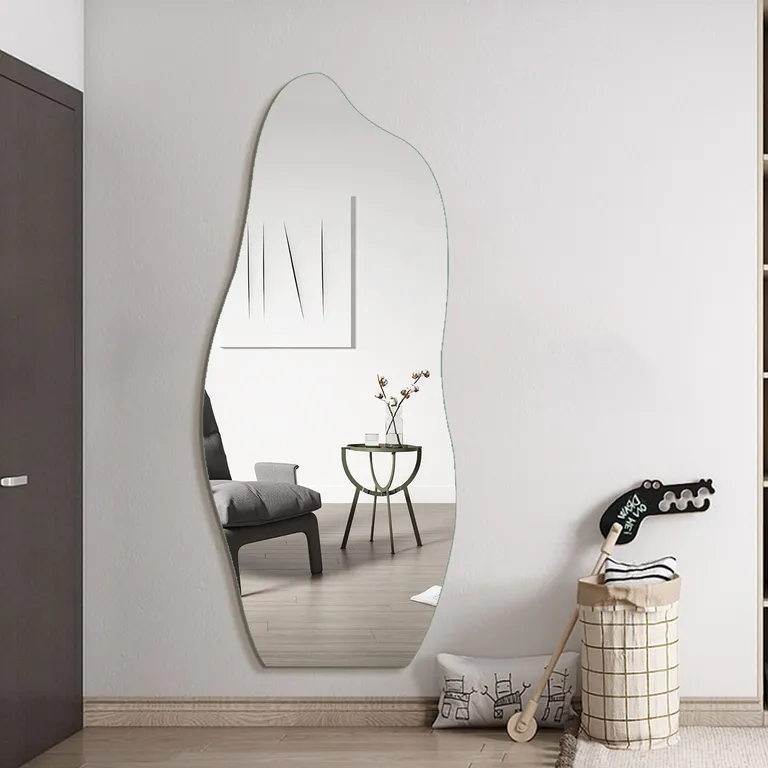
For example, converting a rectangular mirror into an irregular shape may require a different frame structure, revised LED positioning, new mounting points, modified wiring, and specially designed packaging.
Adding Bluetooth speakers, motion sensors, temperature displays, or other smart functions may require changes to the internal structure, power system, control board, heat management, waterproofing, and testing procedures.
Material choices must also be evaluated by engineers. Changing the frame profile, adhesive, mirror backing, anti-fog pad, protective coating, or waterproofing system can affect assembly, weight, durability, and product safety.
China’s large LED mirror industry has allowed manufacturers to build engineering teams with experience across mirror processing, lighting, electronics, structural design, materials, and bathroom-product safety.
This engineering depth is also reflected in the intellectual property developed by established manufacturers. Chengtai Mirror, for example, is backed by more than 70 patents related to mirror products and manufacturing technologies.
This patent portfolio reflects accumulated experience in solving practical design and production challenges. It also gives customers greater design flexibility by providing a broader technical foundation for different mirror shapes, frame structures, lighting layouts, mounting systems, control methods, and integrated functions.
Rather than being limited to a small number of standard models, buyers can work with engineers to adapt existing technical solutions or develop new combinations according to their market positioning, design preferences, installation requirements, and target price.
Patents alone do not guarantee product quality. However, sustained investment in patented designs can indicate stronger engineering resources, greater product-development experience, and more options for customized projects.
Experienced engineers can also recommend changes that improve lighting uniformity, simplify installation, strengthen the product structure, increase corrosion resistance, reduce unnecessary costs, or improve long-term reliability.
This support is particularly valuable for bathroom brands, retailers, hotel projects, and distributors developing their own product collections instead of purchasing only standard factory models.
Professional International Representatives
Strong manufacturing capability must be supported by effective international communication.
Export orders involve more than agreeing on a product price. The supplier must understand dimensions, technical drawings, functions, electrical requirements, target-market certifications, branding, packaging, inspection standards, delivery schedules, and shipping arrangements.
Experienced international representatives connect overseas buyers with the factory. They communicate customer requirements to engineers, purchasing teams, production managers, quality inspectors, packaging specialists, and logistics providers.
This work requires both language ability and manufacturing knowledge.
A representative must be able to understand technical specifications, identify missing information, explain production limitations, coordinate sample revisions, and follow an order from product development through manufacturing and shipment.
China’s long history as an international manufacturing center has created a large group of experienced export sales representatives, project coordinators, merchandisers, and sourcing professionals.
For overseas buyers, a capable international representative can make the difference between simply ordering an existing product and successfully managing a customized OEM or ODM program.
Six of the World’s Top 10 Container Ports Are in China
China’s manufacturing strength is supported by one of the world’s most extensive container-shipping networks.
Based on 2024 container-throughput statistics, six of the world’s ten largest container ports are located in mainland China. Chinese ports also occupy four of the first five positions.
Global ranking | Chinese container port |
|---|---|
1 | Shanghai |
3 | Ningbo-Zhoushan |
4 | Shenzhen |
5 | Qingdao |
6 | Guangzhou |
8 | Tianjin |
This port network gives Chinese manufacturers access to major global trade routes, frequent vessel departures, multiple shipping carriers, substantial container capacity, and alternative departure ports.
These advantages are particularly important for LED mirrors because mirrors are relatively large, heavy, and fragile. Wholesale, retail, hotel, and construction-project orders are commonly transported by full-container or consolidated sea freight.
Manufacturers therefore need more than access to a major port. They also need experience with reinforced cartons, foam protection, corner guards, internal supports, wooden packaging when required, and carefully planned container loading.
The combination of leading ports, experienced freight services, frequent international routes, and specialized export packaging gives Chinese LED mirror manufacturers an efficient connection to international markets.
How These Strengths Shape China’s LED Mirror Industry
China’s position in LED mirror manufacturing has developed through the combined effects of domestic demand, an integrated supply chain, production at scale, materials expertise, skilled labor, engineering capabilities, international business experience, and established logistics infrastructure.
These factors allow manufacturers to work with a broad range of mirror substrates, protective coatings, waterproof materials, frame systems, lighting components, sensors, electronic controls, finishes, and smart functions.
Production at scale can improve cost efficiency, while experienced workers and engineers help maintain consistency and adapt designs for different applications.
As a result, international buyers can access a wide variety of products, from basic illuminated mirrors to more durable, decorative, or multifunctional designs. Dimensions, shapes, lighting systems, frame finishes, controls, electrical configurations, branding, and packaging can also be adjusted for different markets and projects.
The strength of China’s LED mirror industry therefore lies in its ability to combine product quality, commercial value, variety of choice, and customization flexibility within the same established manufacturing environment.
These combined capabilities help explain why China has become a major global production base for LED bathroom mirrors used across residential, retail, hospitality, and commercial markets.